Hardwood floors in a dry climate: what Lubbock homeowners should know
Wood moves with the air around it. In a dry place, that one fact drives almost every good and bad flooring decision.
By Giovanni Home Services, Lubbock, Texas
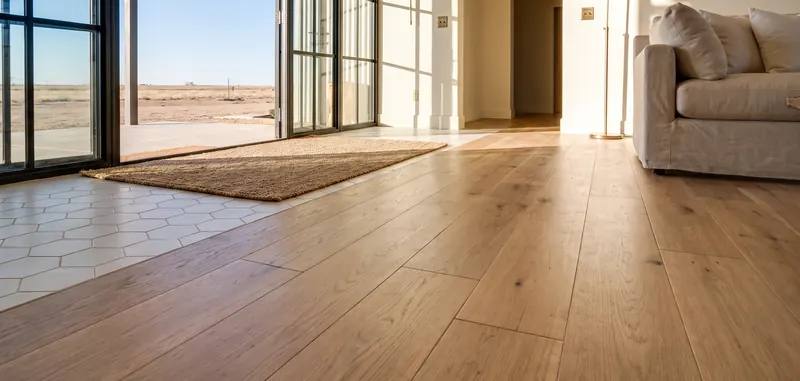
Hardwood floors do well in Lubbock when the wood is matched to your home's dry indoor air before it goes down, and that air is kept steady afterward. Wood shrinks as it dries and swells as it takes on moisture, and here the risk runs toward dry.
Lubbock gets about 18 inches of rain a year. Run the heater through a cold snap and the air inside your house gets drier still. A wood floor feels all of that, and it holds up fine as long as somebody planned for it.
Before you pick a board, it helps to know how wood behaves in a house like yours.
Let the wood adjust to your house before it goes down
Every board holds some water, and the trade measures it as moisture content. Most flooring is made at about 6 to 9 percent, which matches the house many makers have in mind: 30 to 50 percent relative humidity and 60 to 80 degrees. Drop the air to 25 percent humidity and wood wants to settle near 5 percent. That gap is where shrinking comes from.
Acclimation means letting the wood reach the moisture level it'll live at in your house. You know it's there when a moisture meter says so. That commonly takes about 3 to 10 days for solid wood and 2 to 3 for engineered, but the meter gets the last word.
Two things have to be true first. The house has to be closed in, and the heating and cooling has to be running the way it will when you live there. Wood stacked in a garage or in a house with the system off is adjusting to the wrong air.
Over a wood subfloor, the installer checks that too. A common rule of thumb is that the subfloor should be within 4 percent of the flooring for narrow strip under 3 inches, and within 2 percent for plank 3 inches and wider. Wide plank gets the tighter number because it's less forgiving.
Seasonal gaps: what's normal and what isn't
Some gapping is normal. In winter the heater runs, the air dries, and each board shrinks a little. Thin lines open between boards. When the air picks up moisture again, they close. That's a wood floor breathing, and no installer can stop it.
Board width changes how it looks. A wide plank shrinks the same share as a narrow one, but it's all in one board, so the gap beside it is bigger. If small gaps will bother you, go narrower or go engineered.
What isn't normal: gaps that never close, boards that cup so the edges sit higher than the middle, or cracks in the face of the board. Those point to wood that went in at the wrong moisture level, or indoor air that dropped below about 30 percent humidity and stayed there.
Why engineered often behaves better over a slab
Solid hardwood gets nailed or stapled to a wood subfloor. A concrete slab gives it nothing to nail into. So over a slab, the usual answer is engineered wood, glued down or floated.
Engineered is real wood on top, glued to a core of layers that run in crossing directions. Those layers hold each other in check, so the board moves less when the air changes. In a dry climate, that steadiness is worth a lot.
The tradeoff is thickness. An engineered board gives you a wear layer where solid gives you the full board. A thick wear layer can be sanded and refinished. A thin one can't, or not more than once. Ask how thick it is before you fall for a color.
A slab still gets tested for moisture here, dry climate or not. Dry air above doesn't tell you what the concrete is holding. The flooring and adhesive makers set the limits, so a careful installer tests first and adds moisture control if the product calls for it.
Keep indoor humidity between 30 and 50 percent
Hold your house between 30 and 50 percent relative humidity and between 60 and 80 degrees, all year. That's the range many flooring makers call for, so check your product's instructions.
Buy a small humidity gauge and set it in the room with the floor. It'll tell you more than guessing will. If winter readings sit under 30, add a humidifier. A portable unit can handle one room. A whole-house unit on your heating system handles all of it.
Don't shut the system off when you leave for two weeks. Wood doesn't know you're gone. And know what you're signing up for. A hardwood floor here asks you to manage the air. If that sounds like a chore you won't do, read the vinyl and tile section below twice.
Hard water, dust, and grit
Lubbock's water is hard. The city's 2025 water quality report put average hardness at 169 parts per million. Mop with tap water and the minerals stay behind as a dull film when the water dries. People think the finish is wearing out. Often it's residue.
Wood doesn't want a wet mop anyway. Use a barely damp microfiber pad and a cleaner made for your floor's finish. Skip the steam mop. Wipe up spills when they happen.
Dust is the bigger enemy. This is one of the windiest cities in the country, and that fine grit comes in on every shoe and paw. Underfoot, it works like sandpaper. A good mat outside and inside each door does more for your finish than any product. So do felt pads under chairs and a quick sweep or vacuum a few times a week.
Finish choice helps. A matte or satin sheen hides fine scratches and dust far better than gloss. A little grain and color variation hides them better than a dark, flat, uniform floor. Dark glossy floors look great for about an hour after you clean them.
When plank vinyl or tile is the smarter call
We like wood, and we'll still tell you where not to put it. Full bathrooms, laundry rooms, mudrooms, and the back door that leads to the pool are hard on wood. So is a house with big dogs and nobody who wants to think about humidity.
Plank vinyl shrugs off water and needs no humidifier. It still needs a flat subfloor, commonly within 3/16 inch over 10 feet, a moisture check on the slab, and room at the walls to move. The catch is that it can't be refinished. When it wears out, it gets replaced.
Tile is the toughest of the three against grit and water. It's also hard and cool underfoot, and the grout lines need care. In a lot of homes the smart plan is a mix: wood where you live, tile or vinyl where it gets wet.
Patterns and transitions to settle before install
Pattern changes the job more than people expect. A straight lay is the simplest. Running the same floor continuously through several rooms takes more layout but looks calmer. Herringbone uses short pieces and a lot of joints, so it takes more planning, more cuts, and more time. Feature strips and borders sit in between.
Transitions deserve a decision early. Where wood meets tile, the two finished heights have to match, and that gets worked out before either floor goes down. A flush inlay looks far better than a raised strip you stub your toe on. Wood also needs a small space at the walls to move, hidden under the baseboard.
Flooring is a specialty at Giovanni Home Services. Our interiors division installs hardwood, tile, laminate, and vinyl in standard, continuous, and herringbone layouts, with feature strips where they fit. A floor starts with a consultation and a detailed proposal. To talk through your rooms, book a consultation or call (806) 853-7158.
- Most wood flooring is made for homes held at about 30 to 50 percent relative humidity and 60 to 80 degrees, and Lubbock winters can push indoor air below that.
- Acclimation is done when the moisture meter reads right, however many days that takes.
- Thin winter gaps that close again are normal, while cupping, cracks, and gaps that stay open aren't.
- Over a concrete slab, engineered wood is usually the better fit than solid.
- Door mats, felt pads, and a barely damp mop protect a finish from grit and hard water.